Chapter 03 Table of Contents
I. Participants and Context
Between September 29, 2009 and June 8, 2010, Charles A. Harold Jr. exchanged a series of emails with Thomas Herz, a UC Office of the President employee whose departmental title changed three times during the correspondence:
| Period | Thomas Herz’s Title | Phone |
|---|---|---|
| September 2009 | Retiree Insurance, University of California, Office of the President | 510-987-0229 |
| January 2010 | Health & Welfare Administration, University of California, Office of the President | 510-987-0229 |
| March 2010 forward | Retiree Administration Service Center, University of California, Office of the President | 510-987-0229 |
The 510-987 prefix is the UC Office of the President telephone exchange — the same prefix used by Erin Morse (510-987-0762), the RASC Benefits/Insurance Supervisor who issued the April 9, 2026 acknowledgment letter (CRMCASEID1871390). Herz’s final departmental title — “Retiree Administration Service Center” — is the same RASC that in 2026 issued the Williams-Cook denial and the Morse 90-day review letter.
Additional participants copied on the correspondence:
Bridget Sheehan-Watanabe — Health Care Facilitator, UCLA Benefits Office ([email protected]), CC’d on March 29, 2010 email by Herz.
Silvia Zorzoli — [email protected], CC’d on April 9, 2010 email by Harold.
Harold’s email addresses during the correspondence: [email protected] and [email protected], communicating via BlackBerry from T-Mobile.
II. The Complete Herz Correspondence — September 29, 2009 through June 8, 2010
The following is the complete chronological record of every communication between Thomas Herz and Charles A. Harold Jr., reproduced from the original email files. Where multiple copies of the same email exist (forwarded copies, CC copies), the content is presented once with all source files noted.
From: Thomas Herz ([email protected])
To: Charles A. Harold ([email protected])
Subject: SSA determination
“Thanks for taking the time to talk with me about what UC needs from you in the way of a determination from Social Security as to whether you are eligible for disability benefits. When you get a letter ruling on this question, please let us know and send us a copy. If you have any questions, let me know.”
Signed: “Tom Herz, Retiree Insurance, University of California, Office of the President, 510-987-0229.”
From: Charles A. Harold
To: Thomas Herz
Subject: RE: SSA determination
“Thank you Tom. Is there something I need to get from UC that states my status. It has been so long I cannot remember what rating I had. I thought it was over 50%.”
From: Thomas Herz
To: Charles A. Harold
Subject: documents for compliance
“This is to confirm our conversation today about our need for a copy of some sort from SSA once they determine whether you are or are not eligible for disability benefits. Please keep this for reference and let me know when you get some determination from them.”
Signed: “Tom Herz, Health & Welfare Administration, University of California, Office of the President, Phone: 510-987-0229.”
From: Charles A. Harold
To: Thomas Herz
Subject: RE: documents for compliance
“Thanks Tom.”
From: Thomas Herz
To: Charles A. Harold
Subject: document?
“Hello Chuck: What progress have you made in obtaining any document from Social Security as to whether or not you are eligible for SSDI? We still need a copy of a determination from them.”
Signed: “Tom Herz, Retiree Administration Service Center, University of California, Office of the President, Phone: 510-987-0229.”
From: Charles A. Harold
To: Thomas Herz
Subject: RE: document?
“Well I initially logged in and started the process then I didn’t have the info I needed so I got the info and now I can’t get back in the system because my password does not work and I cannot obtain a new password online because I am ‘forbidden’ from doing that under my login so I tried to get them to mail me a password but I can’t do that because I don’t have a password to do that so I am stuck in a Dilbert cartoon and a Joseph Heller novel and I am not interested in wasting my time with the government any longer unless you have another way and this is the longest compound complex run on sentence I have ever seen.
What are your suggestions? I don’t have time to stand in line at the SS office and I am not old enough to be interested in their benefits. Why does the UC need this document. How does it benefit UC or me please?”
From: Thomas Herz
To: Charles A. Harold
Subject: RE: document?
“As far as the cyber snags you are having, I am afraid I don’t have any answers for how to navigate them. I recommend that you call SSA and see about making an appointment at a local office. I always suggest bringing reading material so that you can multi-task there if there is a line and you have something constructive you can do while waiting.
UC needs a determination of whether or not a person is eligible for SS disability benefits as that affects Medicare eligibility. Someone who is deemed eligible will be Medicare eligible after 24 months of benefits. That is the rationale behind our request for this information. If you have further questions, please let me know.”
From: Charles A. Harold
To: Thomas Herz
Subject: RE: document?
“I do not think this applies to me. My retirement settlement stated I have lifetime medical through UC not Medicare or Social Security. Even if I was eligible I do not think it applies to my retirement agreement. Can you check on this please. The way I read the UC news letter I received last month, if I am eligible for SS I fall into Medicare and I am off UC Anthem Blue Cross. That will not work for me or the family. Am I incorrect?”
From: Thomas Herz
To: Charles A. Harold
Subject: RE: document?
“The requirement does apply to you as it does to all other retirees on disability.”
“Lifetime medical is not a vested benefit for any UC retiree although we have provided this benefit for decades. It has moved into the realm of myths in the oral tradition since there is nothing in writing in our guidelines that promises this in perpetuity. Retiree medical coverage is subject to annual approval from the regents based on the state budget allocations.”
“It is also not the case that if you (or any other UC retiree) becomes Medicare eligible that you fall off of Anthem or any insurance carrier you may be covered by through University benefits. What happens is you transition into the Medicare version of the Anthem Blue Cross plan you are already in. Your cost and UC’s cost to the carrier goes down since Medicare becomes primary and Anthem is secondary payer. Your copays remain basically the same.”
“Of course, if you are not eligible for SSDI, which would make you Medicare eligible after 24 months, then we still need a copy of the denial of SSDI benefits. In that scenario, you remain in the non Medicare version of the medical plan.”
“I hope this helps clarify our requirements. Either way, we need a copy of the finding from SSA. This is why I advised you to go down and make the query. Without such documentation, you remain out of compliance and jeopardize your UC medical benefits.”
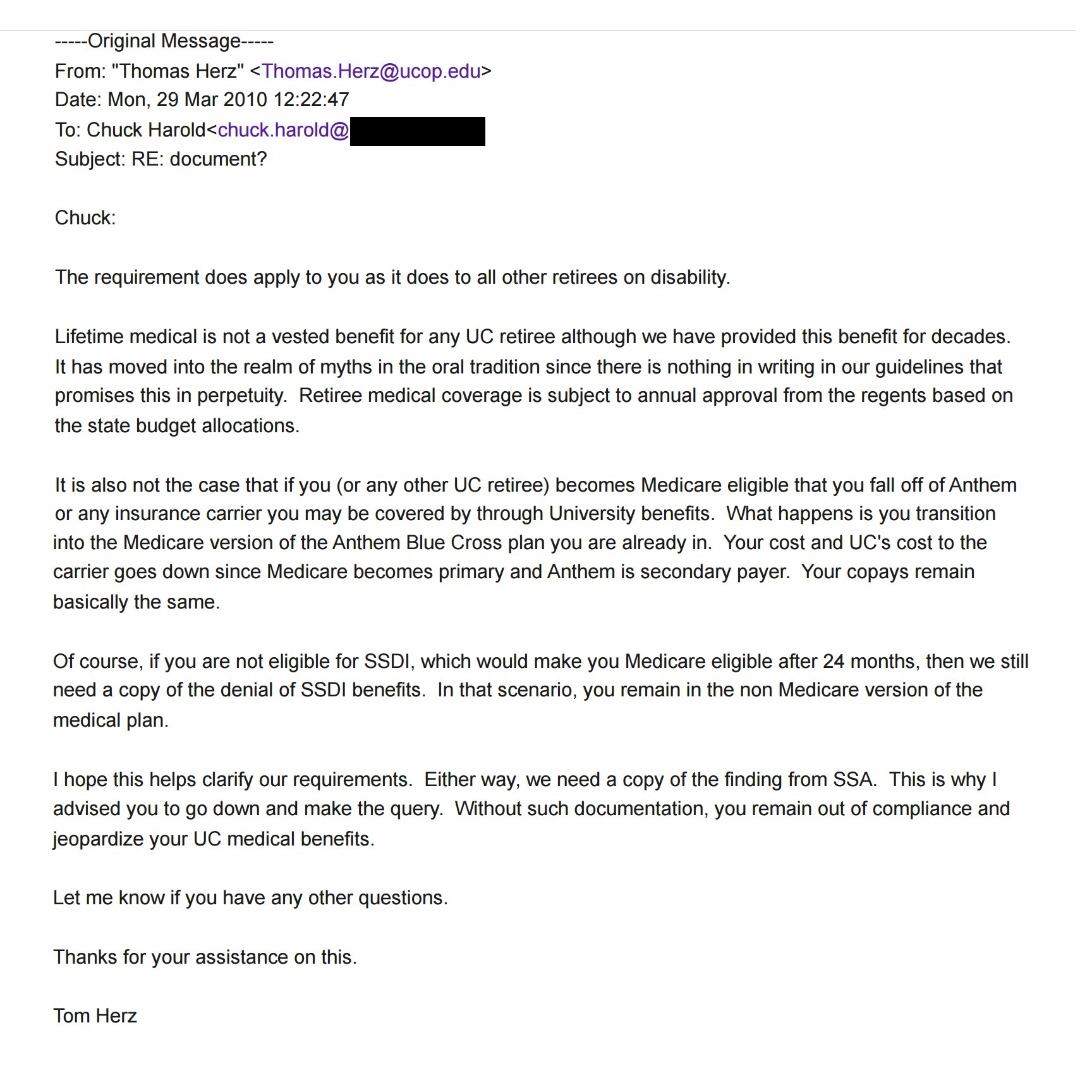
Thomas Herz to Charles A. Harold — March 29, 2010, 12:22 PM PDT — Subject: RE: document?
This single email — dated March 29, 2010, 12:22 PM PDT — contains five statements that directly parallel the conduct patterns alleged in the DOJ’s complaint in United States ex rel. Shea v. eHealth, Inc., et al., No. 1:21-cv-11777-DJC (D. Mass.), filed May 1, 2025. The Shea case alleges a systematic scheme by Elevance Health (Anthem’s parent company) and affiliated brokers to steer, misrepresent, and discriminate against Medicare beneficiaries. Every element of that alleged scheme appears in this email:
| Herz Statement | Shea Conduct Pattern |
|---|---|
| “All other retirees on disability” — confirms Harold’s disability classification | Discrimination against disabled beneficiaries. The DOJ alleges disabled beneficiaries were systematically filtered out because they were considered less profitable. Herz confirmed Harold was in that exact category. |
| “Your cost and UC’s cost to the carrier goes down” — the financial motive admission | Concealing financial incentives. The DOJ alleges kickbacks were disguised as marketing. Herz put the cost-savings motive in writing — UC and Anthem both save money when the retiree moves to Medicare-primary. |
| “Moved into the realm of myths in the oral tradition” — dismisses a written WCAB settlement as folklore | Steering beneficiaries away from best-fit plans. The DOJ alleges brokers steered enrollees regardless of what was best for them. Herz dismissed the legal agreement governing Harold’s rights and steered him toward SSDI anyway — without reading the settlement Harold asked him to check. |
| “You remain out of compliance and jeopardize your UC medical benefits” — the compliance threat | Misrepresenting guaranteed issue rights. The DOJ alleges agents made material misrepresentations about enrollment rights. Herz misrepresented the consequences of non-compliance to coerce Harold into an action that was not required under his settlement. |
| Threat never enforced — Harold did not comply. No offset fee was imposed. No coverage was terminated. Herz disappeared after June 8, 2010. Coverage continued uninterrupted for five more years. | Deliberate delay as a weapon / False certifications. The DOJ alleges brokers used pressure tactics to prevent beneficiaries from staying in preferred plans. Herz used a deadline threat to create urgency, then disappeared when Harold did not comply — proving the “requirement” was manufactured coercion, not administrative policy. |
Five statements. Five federal case parallels. One email. One date: March 29, 2010, 12:22 PM.
Cross-reference: These five parallels are analyzed in full in Chapter 12 — The Playbook Exposed, Section IV-B and the Conduct Pattern Table (Section X).
From: Charles A. Harold
To: Thomas Herz
Subject: RE: document?
“Good explanation for most UC retirees. What I am saying is that I have a specific legal settlement with UC that I believe makes me an exemption to the UC insurance rule. I negotiated lifetime medical coverage from UC. Perhaps we should look into this more before we proceed? I just want to make sure I am not violating or modifying my own agreement by making improper choices.”
From: Thomas Herz
To: Charles A. Harold
CC: Bridget Sheehan-Watanabe, Health Care Facilitator, UCLA Benefits Office ([email protected])
Subject: RE: document?
“I am not aware of any settlements that UC has made that specifically exempts one individual from the general insurance regulations that govern this process and I doubt that legal counsel would have established this kind of precedent in your case.”
“I am sending a cc of this to Bridget Sheehan-Watanabe, the Health Care Facilitator at the UCLA Benefits Office in the hopes that you may want to get this further clarified with her. She is very knowledgeable and savvy and has assisted numerous employees and retirees in matters like this.”
“It seems highly unlikely that getting a determination from SSA as to whether you are eligible for their disability benefits would in any way jeopardize or countermand your settlement with UC.”
“I hope this helps illuminate that matter a little more and that you avail yourself of the expertise available at UCLA as well as this office to remain in compliance.”
From: Charles A. Harold
To: Thomas Herz
Subject: RE: document?
“Thanks Tom.”
From: Charles A. Harold
To: Charles A. Harold (self-forwarded for records preservation)
Subject: Fw: document?
Harold forwards the entire email chain to his own sbcglobal.net address for his records. Two forwarded copies exist.
From: Thomas Herz
To: Charles A. Harold
Subject: documentation
“I would encourage you to call and set up an appointment with Social Security. Many of our retirees have been able to schedule phone appointments and do much of this with SSA staff on the phone. After an initial phone session, it may be necessary to have a follow up at the local SSA office.”
“In any event, UC does need to see something in writing from SSA that addresses the question of whether or not you are eligible for SS disability as this will determine your potential eligibility for Medicare prior to age 65. Failure to provide this determination, either in the affirmative or negative, can result in an offset fee being imposed on your check and termination of UC medical coverage.”
“Our office would need something to this effect by May.”
From: Charles A. Harold
To: Thomas Herz
Subject: RE: documentation
“I think I have figured it out and should have the questionnaire finished by this weekend. I would like you to check with your legal department about my settlement before you decide on any action regarding my insurance. I think you will find it was a unique case.”
From: Thomas Herz
To: Charles A. Harold
Subject: RE: documentation
“We will await a copy from you of the determination made by SSA. Please keep me informed as you know when it can be expected.”
From: Charles A. Harold
To: Thomas Herz (CC: [email protected] on second email)
Subject: RE: documentation
11:22 AM: “Here is the application. Now it says I have to apply for benefits.”
11:27 AM: “I tried to apply for benefits as it stated on the form but it would not let me because it said I need to be 61 years or older. So now what?”
From: Thomas Herz
To: Charles A. Harold
Subject: RE: documentation
“I am surprised to hear that you are being prevented from applying for SS disability benefits due to being under 61 as a number of UC people on UCRP disability have applied for SSDI and some have been awarded them despite being considerably younger than 61. Could it be that there is some other type of SS disability benefits to which you have not been directed that may allow you to submit an application? Please remember that all we need is something in writing from Social Security Administration stating that you are ineligible for their disability benefits.”
From: Charles A. Harold
To: Thomas Herz
Subject: RE: documentation
11:43 AM: “I click on the exact link at the bottom of the page where they directed me and received that message. I will send you a screen shot of the application that says that. I am going to go over to the ss office now and try and get this straightened out. Our tax dollars at work hey?”
12:51 PM (from the SSA office): “It turns out I am not crazy. I am in the SS office and the guy tells me I was blocked from proceeding because I did not meet the criteria. Anyway ss is completing what they need and a letter will be generated automatically. It will be several weeks until it is mailed but I will be complete with what I can do today.”
From: Thomas Herz
To: Charles A. Harold
Subject: SSA letter?
“In late April it was estimated that it might take a few weeks for you to receive a letter from SSA as to whether you were eligible for SSDI. Can you give me an update on this situation?”
From: Charles A. Harold
To: Thomas Herz
Subject: RE: SSA letter?
“I was just thinking about that myself today. The SSA rep told me it could take several months for a formal letter but he did say that since I earned more than 12K per year I was automatically ineligible for disability benefits. I will stop by and see them this week.”
This is the last email in the series. There is no email showing Herz ever received the SSA determination letter, nor any email showing what action UC took based on the outcome. The correspondence ends with Harold reporting he was ineligible for SSDI — which, under Herz’s own stated rationale, meant Harold would NOT become Medicare-eligible through SSDI and would “remain in the non Medicare version of the medical plan.” Yet Harold eventually did transition to Medicare — not through SSDI, but at age 65 (standard eligibility). Herz’s entire 2009–2010 compliance campaign was ultimately moot, but the classification it confirmed — “retiree on disability” / “UCRP disability” — and the coverage structure it described — “the Medicare version of the Anthem Blue Cross plan you are already in” — remain the documented institutional record of what UC’s own RASC believed Harold’s status and entitlement to be.
III. What the Herz Correspondence Establishes
When the 24 emails reproduced above are placed against the full documentary record, the Herz correspondence establishes six independent factual findings. Each finding is drawn exclusively from UC’s own employee’s documented statements.
UC’s own 1099-R for tax year 2009 — the same year the Herz correspondence began — reports Harold’s distribution as Code 3 (Disability) with $30,059.57 in gross distributions and $2,200.24 taxable (7.3%). Every January, UC mailed Harold a 1099-R — the same tax form every retiree in America receives from their pension. On that form, there is a small box labeled “Distribution Code.” UC filled in Code 3 — the IRS code that means “this person is disabled.” That code told the IRS to treat most of Harold’s income as tax-free, because federal law protects disability income differently than regular retirement income. In January 2010, UC mailed Harold that form for tax year 2009. That same September, Thomas Herz — a UC employee in the same retirement office that prepared the form — was writing Harold emails calling him a “retiree on disability.” The form and the emails said the same thing. UC knew what Harold was. They put it in writing to him and filed it under penalty of perjury with the IRS.
What Herz did next presents UC with a problem that has only two doors, and both lead to the same place.
Door 1: Herz knew Harold’s earnings. He worked in the same RASC office that prepared the 1099-R showing $30,059.57 in gross distributions for 2009. That is over $30,000 a year — well above the SSDI Substantial Gainful Activity threshold of $12,000 per year ($1,000 per month). If Herz knew what Harold earned, then he knew Harold could never qualify for SSDI, which means the entire compliance campaign — the nine months of emails, the threats, the May deadline, the demand that Harold physically go to a Social Security office — was pointless from day one. Herz was sending Harold on a fool’s errand. The question becomes: why?
Door 2: Herz did not know Harold’s earnings. He did not have access to the file. He did not know about the workers’ compensation settlement. He called the settlement a “myth.” He did not know Harold’s classification history. If this is the case, then UC’s records were already so broken in 2009 that a RASC employee administering disability retiree compliance did not know what his own office was paying Harold or how it was classified. Karl T. Ross said Harold resigned. Ida Fong, eleven years later, could not find Harold’s disability records. The 1099-R said Code 3 — Disability. Herz said “retiree on disability.” No one was looking at the same file because there was no single file.
Both doors lead to the same place. Either UC’s RASC knowingly pushed a disabled retiree through a process he could never qualify for — or UC’s record-keeping was so fragmented that the office administering disability compliance did not know its own retiree’s classification and earnings. Either way, the institution failed. Either way, the direction of the push was the same: toward SSDI, toward Medicare eligibility, toward shifting Harold off UC’s books.
This is the Schrödinger’s Retiree problem reduced to its simplest form. Harold’s status changes depending on which UC employee opens the box. Herz opens the box and sees “retiree on disability.” Karl T. Ross opens the box and sees “resigned.” Williams-Cook opens the box and sees “elected regular retirement.” Captain Chobanian opens the box and sees “medically separated.” The 1099-R opens the box and sees Code 3 — Disability. They cannot all be right.
This is the Schrödinger’s Retiree problem reduced to its simplest form. Harold’s status changes depending on which UC employee opens the box. Herz opens the box and sees “retiree on disability.” Karl T. Ross opens the box and sees “resigned.” Williams-Cook opens the box and sees “elected regular retirement.” Captain Chobanian opens the box and sees “medically separated.” The 1099-R opens the box and sees Code 3 — Disability. They cannot all be right.
But every single one of them produces the outcome least favorable to Harold at the moment it is applied.
The reader will encounter this pattern again. In Chapter 12, the Department of Justice alleges that Elevance Health — the parent company of Anthem Blue Cross, Harold’s insurer throughout this entire period — paid brokers $262 million to steer Medicare beneficiaries away from coverage that was expensive for the insurer and into programs that shifted costs to Medicare. The Shea complaint alleges that Elevance Health’s broker network used different tools — kickbacks, call routing, agent coaching — but always in the same direction: push disabled beneficiaries away from coverage that is expensive for the insurer. UC used different tools — compliance threats, coerced conversion, a Via Benefits transfer — but always in the same direction: push Harold away from coverage that is expensive for UC and its insurer, Anthem Blue Cross, an Elevance Health subsidiary.
Harold had Anthem Blue Cross coverage the entire time. Every institutional push moved in the direction that would benefit both UC and Anthem. The documented record speaks for itself.
IV. The 2015 Coerced Conversion
Five years after Herz confirmed Harold’s disability classification in 2010, the documented record shows the following sequence:
In or around 2015, Harold received a call from a female UC representative who stated he must convert his classification from Duty Disability Income to Retirement Income or he would stop receiving any income. This individual claimed she knew nothing about Harold’s workers’ compensation settlement or lawsuit. Harold was told he had two options: submit to a medical examination for a condition already determined to be permanent and stationary (Octagon Risk Services, August 8, 2001), or convert to regular service retirement. Harold complied under that threat.
This is reflected in Williams-Cook’s February 27, 2026 determination, which states: “You elected regular retirement in June 2015.”
The word “elected” requires examination against UC’s own 1099-R data.
2014 (last full disability year — Distribution Code 3):
Gross Distribution: $33,188.26
Taxable Amount: $2,429.25
Tax-free portion: $30,758.01
Approximately 92.7% of Harold’s pension income was tax-exempt under the disability classification.
2016 (first full “regular retirement” year — Distribution Code 2):
Gross Distribution: $27,767.01
Taxable Amount: $27,767.01
Tax-free portion: $0.00
100% of Harold’s pension income became taxable. Gross distribution dropped by $5,421.25 per year.
Additionally: Harold became obligated to pay $727.48 per month ($8,729.76 annually) in insurance premiums for coverage that was previously provided under the workers’ compensation settlement (“UC will continue to pay all medical bills” — Octagon letter, August 8, 2001).
Lost IRC § 402(l) exclusion: Up to $3,000 per year in additional tax benefit Harold could not claim because UC never reported premium deductions on the 1099-R.
From Harold’s perspective at the moment of the 2015 phone call, the choice presented was not “tax-free disability income vs. taxable retirement income.” The choice presented was: switch or lose EVERYTHING. Under that framing — a UC employee telling Harold all coverage will be terminated if he does not comply — taking a financial hit was the rational choice because the alternative presented was total loss. Harold did not make an irrational financial decision. Harold made the only decision available to him under the threat as stated. The “election” was rational ONLY because UC manufactured the duress. Remove the threat, and no rational person makes that deal.
The pattern is identical to the Herz correspondence five years earlier: a UC employee who has no knowledge of Harold’s workers’ compensation settlement applies general policy to Harold’s case, threatens termination if he does not comply, and does not investigate the specific legal agreement governing his benefits.
The documented record now contains two separate instances — five years apart, involving two different UC employees — of the same institutional play: contact Harold, claim no knowledge of his settlement, apply general policy, threaten loss of benefits, push him toward a reclassification that shifts costs away from UC. The first attempt (Herz, 2009) failed because Harold was ineligible for SSDI. The second attempt (2015) succeeded because the threat was more direct: convert or lose everything. Both attempts bypassed the WCAB. Neither employee consulted Harold’s settlement file.
The 2015 conversion occurred one year before the Department of Justice’s documented kickback scheme began (2016–2021). The Herz correspondence extends the same behavioral pattern back to 2009 — seven years before the DOJ’s timeline. Harold’s insurer throughout both periods was Anthem Blue Cross, an Elevance Health subsidiary — the defendant in United States ex rel. Shea v. eHealth, Inc., et al.
This pattern did not exist in hindsight. It created itself in real time — contemporaneous documents, generated by UC’s own employees, in UC’s own emails, on UC’s own 1099-R filings — across a decade of institutional conduct that Harold had no reason to anticipate and no ability to fabricate.
The question for the Plan Administrator: Why would any rational person voluntarily relinquish tax-free disability income and employer-paid medical insurance in exchange for fully taxable income, a reduced pension, and $727.48 per month in insurance premiums? Please identify what financial or coverage benefit Harold received from this “election” that would explain why a reasonable person would voluntarily make it.
V. The Legal Void — Labor Code § 5803 and § 5804
Under California Labor Code § 5803, the Workers’ Compensation Appeals Board (WCAB) retains continuing jurisdiction over workers’ compensation awards. Under Labor Code § 5803, the WCAB has exclusive authority to “rescind, alter, or amend any order, decision, or award” relating to disability, and this requires notice and opportunity to be heard.
Harold’s disability classification and lifetime medical coverage were established by the 2003 workers’ compensation settlement (Claim No. 199650445, attorney Dennis Hargrove). That settlement is a WCAB-approved disposition. The Octagon permanent disability determination of August 8, 2001 has never been revoked.
For Harold’s disability classification to be legally changed — for him to move from disability status to regular retirement status — a WCAB proceeding was required. Not a phone call from a UC benefits employee. Not a form. Not an “election.” A formal WCAB proceeding with notice and opportunity to be heard, resulting in a modification order.
No such proceeding ever occurred. No WCAB modification order exists on the record.
This connects directly to the Herz correspondence: Herz in 2010 was already treating Harold’s disability classification as subject to general UC administrative policy — telling Harold he had to comply with SSA documentation requirements “as it does to all other retirees on disability,” and threatening termination of coverage for non-compliance. Herz never mentioned the WCAB. Herz never referenced the settlement. Herz applied administrative compliance rules to a workers’ compensation beneficiary whose status could only be modified by the WCAB. Then in 2015, a different UC employee did the same thing — applied administrative process (a phone call and an enrollment form) to accomplish a classification change that legally required a WCAB proceeding.
The pattern across 2010 and 2015: UC has repeatedly treated Harold’s workers’ compensation settlement as if it were a standard administrative enrollment decision subject to UC’s internal policies, when in fact it is a WCAB-approved legal disposition subject to the WCAB’s exclusive continuing jurisdiction under Labor Code §§ 5803 and 5804.
The question for the Plan Administrator: Please produce the WCAB modification order authorizing the change in Harold’s classification from disability to regular retirement in June 2015. If no such order exists, please state for the record by what legal authority UC changed a classification established by a WCAB-approved workers’ compensation settlement.
VI. The Records Disappearance
The Herz correspondence is the last clean snapshot of what UC actually knew about Harold’s classification before the records chaos began. The following timeline documents what happened after Herz’s 2010 confirmation:
2010–2014: UC’s IRS Form 1099-R filings use Distribution Code 3 (Disability). Account number remains AS 0010747. Stable.
2015: Female UC representative calls Harold, claims no knowledge of his settlement, tells him he must convert or lose everything. Harold complies under duress. UC issues TWO corrected 1099-R forms — the only year with multiple corrected forms. Distribution Code changes from 3 to 2. Account number remains AS 0010747.
2016–2019: Distribution Code now 2 (Early Distribution). 100% of pension income taxable. Harold paying $727.48/month in premiums. Account number still AS 0010747 — stable for a full decade (2010–2019).
2020: FIRST account number change in a decade. UC assigns TWO sequential new numbers (AS 0011041 and AS 0011042) to the same pension in the same tax year. One gets Code 2, the other gets Code 7. December 24, 2020: Accellion data breach — 547,000+ individuals. Disability accommodation data exposed.
2021: Another new account number: AS 0011451. RASC analyst Ida Fong discovers Harold’s son Max erroneously coded as “disabled” in UC’s system. Max has never been disabled. Fong admits records were “lost during computer system upgrades.” She cannot find Harold’s disability records. Seven separate Anthem data breaches documented this year.
2022: Another new account number: AS 0011572.
2023: Another new account number: AS 0011958. Captain Jeff Chobanian accesses Harold’s personnel file, classifies him as “medically separated,” denies CCW.
2024: Another new account number: AS 0012183.
2025: Another new account number: AS 0012451.
February 17, 2026: UCLA CFO Stephen Agostini publicly confirms erroneous financial records since 2002. Agostini is fired the same day.
February 27, 2026: Williams-Cook issues determination based on “our records indicate” — without identifying which records, from which system, reviewed by whom, or referencing the settlement.
Seven account number changes in six years after a decade of stability. Account numbers in a pension system do not change by themselves. Each change means someone or something accessed and modified Harold’s record. The fact that the changes cluster starting in 2020 (data breach year) and continue annually through 2025 is a factual correlation. Whether the changes were caused by breach remediation, system migrations, manual record modifications, or something else — UC has the logs and UC can answer that question. That is an audit question.
The question for the Plan Administrator: What happened to Harold’s records between Herz’s 2010 confirmation of disability status and Williams-Cook’s 2026 denial of disability status? UC’s own RASC confirmed the classification. Then the records disappeared. Then UC issued a determination contradicting the classification its own office had confirmed. Under California Evidence Code § 413, the failure to produce records within a party’s control permits the inference that those records would be adverse to the party that failed to produce them. Under Cal. Code Regs. Title 8, § 15400.2, claim files where future benefits may be payable “shall not” be destroyed.
VII. The Sixth Contradictory Classification
Herz’s “retiree on disability” classification adds a sixth contradictory UC determination of Harold’s employment status to the five already documented in this record:
| # | Classification | Source | Date |
|---|---|---|---|
| 1 | “Resigned” | Karl T. Ross (named defendant, SC022125) | Pre-1996 |
| 2 | Permanent disability recipient — “UC will continue to pay all medical bills” | Octagon Risk Services, Workers’ Comp Claim No. 199650445 | August 8, 2001 |
| 3 | “RETIRED” | CCW permits issued by Chief Chapman (2002) and UCLA PD (2013) | 2002, 2013 |
| 4 | “Retiree on disability” / “UCRP disability” | Thomas Herz, UCOP RASC (Emails 9 and 20) | 2009–2010 |
| 5 | “Medically separated” / “Active retiree” | Captain Jeff Chobanian, Badge #307, UCLA PD | August 2023 |
| 6 | “Elected regular retirement” / “Not receiving UCRP Disability Income” | Jeanine Williams-Cook, Benefits Analyst III, RASC | February 27, 2026 |
Six different UC determinations. Six different classifications. One employee. Twenty-five years. Each determination was made by a UC employee or UC-contracted entity acting within their institutional authority. No two determinations agree on what Harold is.
Herz’s classification (Row 4) is of particular significance because it came from inside RASC itself — the same office that in 2026 issued the Williams-Cook determination (Row 6) stating Harold was NOT a disability retiree. UC’s own RASC classified Harold as a “retiree on disability” in 2010. UC’s own RASC classified Harold as having “elected regular retirement” in 2026. The same office. Opposite conclusions. Sixteen years apart. No WCAB modification order between them.
VIII. The Question No One at UC Can Answer
The Herz correspondence, when combined with the 2015 coerced conversion, the 1099-R data, the records disappearance, and the six contradictory classifications, produces two questions that the Plan Administrator must answer:
UC’s records state that Harold “elected regular retirement in June 2015.” Under Harold’s disability classification (Distribution Code 3), approximately 92.7% of his pension income was tax-exempt, and his medical coverage was provided under the workers’ compensation settlement at no premium cost to Harold. Under the regular retirement classification (Distribution Code 2/7), 100% of his pension income became taxable, his gross distribution decreased by $5,421.25 per year, and he became obligated to pay $727.48 per month in insurance premiums. Please identify what financial or coverage benefit Harold received from this “election” that would explain why a reasonable person would voluntarily make it.
Herz Finding 2 — The Legal Authority Question:
Please produce the WCAB modification order authorizing the change in Harold’s classification from disability to regular retirement in June 2015, as required under Labor Code § 5803 and § 5804. If no such order exists, please state for the record by what legal authority UC changed a classification established by a WCAB-approved workers’ compensation settlement (Claim No. 199650445, 2003, attorney Dennis Hargrove) and confirmed by UC’s own RASC employee (Thomas Herz, 2009–2010).
IX. Chapter Exhibits
The following exhibits are referenced in this chapter. Exhibit numbers are sequential within this chapter. Source filenames correspond to the original email files as preserved by Harold.
| Ex. | Document Description | Date |
|---|---|---|
| EX 01 | Herz to Harold — Initial SSA determination request; Harold reply asking for UC disability rating documentation | Sept. 29, 2009 |
| EX 02 | Herz to Harold — “documents for compliance” confirmation; title change to Health & Welfare Administration | Jan. 22, 2010 |
| EX 03 | Harold to Herz — SSA system access problems; asks why UC needs this document | Mar. 8, 2010 |
| EX 04 | EX 04b | Complete March 28–29, 2010 thread — Harold invokes settlement; Herz classifies Harold as “retiree on disability,” calls settlement a “myth,” describes Anthem Medicare supplement coverage; Harold asks Herz to verify settlement with legal (first request) | Mar. 28–29, 2010 |
| EX 05 | Herz to Harold (CC: Sheehan-Watanabe) — “not aware of any settlements,” refuses to check with legal, assures Harold settlement is not jeopardized without having read it | Mar. 29, 2010 |
| EX 06 | EX 06b | Harold self-forwarded email chain — records preservation | Mar. 29, 2010 |
| EX 07 | Herz to Harold — Escalation: threatens “offset fee” and “termination of UC medical coverage”; sets May deadline | Apr. 6, 2010 |
| EX 08 | EX 08b | April 9, 2010 thread — Harold’s second request to check with legal (ignored by Herz); Herz classifies Harold as “UCRP disability”; Harold reports SSA online system blocked him | Apr. 8–9, 2010 |
| EX 09 | EX 09b | Final emails — Herz follow-up on SSA letter; Harold reports SSA determination of ineligibility (earned over $12K/year) | June 8, 2010 |
Documents referenced herein that were created by UC, issued by UC, filed by UC, retained by UC, or filed with the IRS under penalty of perjury, or generated by UC’s own contracted insurer, are UC’s own institutional record. Documents created by the undersigned were created in direct response to UC’s own records and communications. Where UC’s own institutional records are not produced to clarify this audit, the author will rely on California Evidence Code § 413, under which the failure to produce evidence within a party’s control permits the inference that such evidence would be adverse to the party withholding it.
Submitted for Regulatory Review and Public Accountability

Charles A. Harold Jr.
UCLA Police Department (Retired?), Badge #341
Founder and First President, Federated University Police Officers’ Association (FUPOA)
I affirm that the information contained in this document and its exhibits is true and accurate to the best of my knowledge and good faith belief, submitted under the protections of 31 U.S.C. § 3730(h) (False Claims Act anti-retaliation) and California Labor Code § 1102.5.